

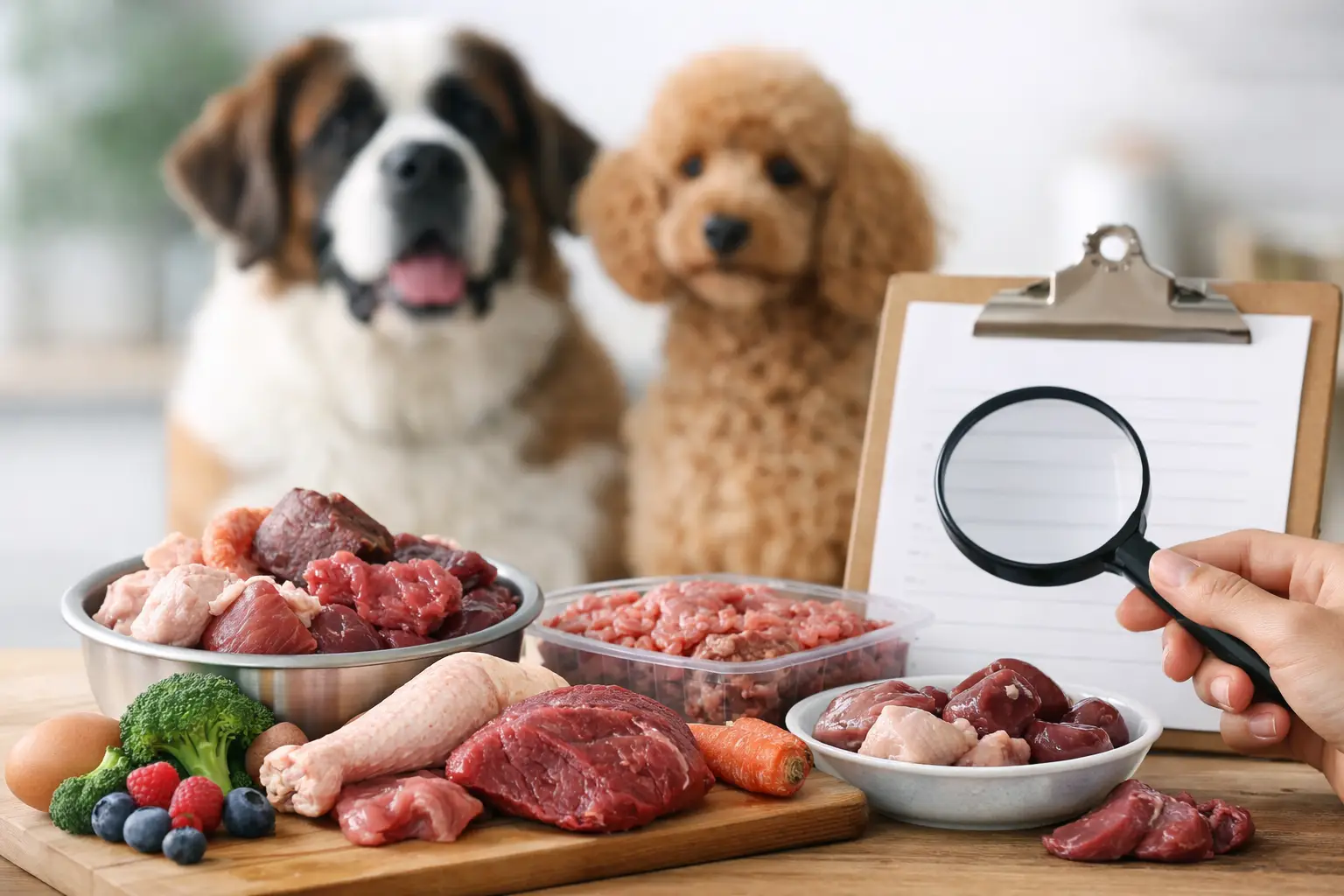
A freezer full of raw food can look like a major step up from a bag of kibble. It can be. But a polished package and a long ingredient list do not tell you whether the food is right for your dog or cat. This guide to reading raw pet food labels will help you separate useful nutrition information from marketing language, so you can choose meals based on what actually goes into the bowl.
Start With the Nutritional Adequacy Statement
The most useful sentence on a raw pet food label is often printed in small type. Look for a nutritional adequacy statement, sometimes called an AAFCO statement. It tells you whether the recipe is intended to provide complete daily nutrition or whether it is meant only for supplemental or intermittent feeding.
For a dog or cat eating a food as the main diet, look for language such as: “formulated to meet the nutritional levels established by the AAFCO Dog Food Nutrient Profiles” or “complete and balanced” for a specific life stage. That life stage matters. A food designed for adult maintenance may not be appropriate for growing puppies, kittens, pregnant pets, or nursing mothers.
Some raw products are designed as toppers, mixes, or prey-style components rather than complete meals. There is nothing automatically wrong with those products. They can fit into a carefully planned feeding program. The problem comes when a pet owner assumes that meat, bone, and organs automatically equal a balanced long-term diet. Balance requires the right nutrients in the right amounts, including minerals and vitamins that may not be obvious from the ingredient panel.
Cats deserve extra attention here. Cats have nutritional requirements that differ from dogs, including taurine and specific vitamin and fatty acid needs. A raw meal made for dogs should not be treated as a complete cat food unless the label clearly says it is formulated for cats or for all life stages of both species.
Read the Ingredient List Without Getting Distracted
Ingredients are listed by weight before processing. That means fresh meat, which naturally contains a lot of water, will often appear near the top. It is still a valuable ingredient, but the list does not tell you the final percentage of protein from that ingredient after moisture is accounted for.
Start by looking for clear, named animal ingredients. “Beef,” “turkey heart,” “chicken liver,” and “sardines” tell you what your pet is eating. Named proteins make it easier to avoid known sensitivities and to rotate proteins with purpose. Vague terms such as “animal fat” or “meat by-products” give you less clarity about species and sourcing.
A quality raw recipe can include muscle meat, organs, bone or a measured mineral source, and carefully selected supplements. Each has a job to do. Muscle meat contributes protein and amino acids. Organs provide concentrated nutrients. Bone or another calcium source helps balance the phosphorus naturally present in meat. Supplements may supply vitamin E, iodine, zinc, copper, taurine, or other nutrients needed to make a recipe complete.
Do not assume supplements are a red flag. In fact, a short supplement section can be a sign that the maker has formulated the food instead of relying on guesswork. The better question is whether the ingredients are identifiable and whether the food is labeled as complete and balanced for your pet’s life stage.
What “human-grade” should tell you
Human-grade is a meaningful claim only when it applies to the finished food and its handling, not simply to one ingredient. A trustworthy company should be able to explain its sourcing and production standards plainly. Locally sourced ingredients can be a real advantage for traceability and freshness, but local alone does not prove nutritional adequacy. Look at the entire label, not one attractive claim on the front of the package.
Use Guaranteed Analysis the Right Way
The guaranteed analysis lists minimum crude protein and crude fat, plus maximum crude fiber and moisture. It is a required starting point, but it is not a full nutrition report. “Crude” is a laboratory measurement term, not a statement about ingredient quality.
Raw foods generally carry far more moisture than kibble. Comparing the protein percentage on the package can therefore be misleading. A raw food showing 12% protein may provide more protein on a dry-matter basis than kibble showing 26% protein.
To make a simple dry-matter comparison, subtract moisture from 100. Then divide the nutrient percentage by that result and multiply by 100. For example, a food with 12% protein and 70% moisture has 30% dry matter. Twelve divided by 30 equals 40%, so the food is 40% protein on a dry-matter basis.
That calculation is useful when comparing similar products, but it should not become the only deciding factor. Pets need calories, essential amino acids, fatty acids, minerals, and vitamins, not just a big protein number. A highly active dog may do well with a higher-fat recipe, while a dog prone to pancreatitis may need a lower-fat plan directed by a veterinarian. For cats, animal-based protein and appropriate nutrient formulation are especially central.
Look Beyond the Big Front-Label Claims
Words like “natural,” “premium,” “ancestral,” and “biologically appropriate” may describe a brand’s approach, but they do not replace a complete label review. They are not a guarantee that a food fits your pet’s age, health status, calorie needs, or feeding plan.
Pay closer attention to the specific details: the species named in the ingredients, the adequacy statement, calories per container or per pound, the manufacturer’s name and contact information, lot identification, and safe-handling directions. A company that makes raw food responsibly should give customers enough information to identify a batch and handle the product correctly.
Calorie information is especially helpful when comparing price. A less expensive package is not necessarily a better value if it delivers far fewer calories or requires a much larger daily portion. On the other hand, the most expensive option is not automatically better if the label offers no clear sourcing, formulation, or feeding information. Compare cost per day for your pet, not just cost per package.
Check Feeding Directions, Then Watch Your Pet
Feeding directions are a starting point, not a command. A label may recommend feeding a percentage of body weight or a daily amount based on calories. Your pet’s ideal portion depends on age, activity level, body condition, metabolism, treats, and whether they need to gain or lose weight.
Use the package recommendation to begin, then monitor the dog or cat in front of you. You should be able to feel the ribs with light pressure without seeing sharply protruding bones. Watch stool quality, energy, coat condition, appetite, and steady body weight. Make changes gradually, particularly when switching from kibble or changing proteins.
If your pet has kidney disease, pancreatitis, recurring urinary issues, allergies, digestive disease, or another diagnosed condition, bring the label to your veterinarian before changing foods. Raw feeding is not a one-size-fits-all decision, and a label cannot replace medical guidance.
Raw Food Labels Also Carry a Handling Plan
Raw food safety begins before the meal reaches the bowl. Read storage and handling instructions as carefully as the ingredient list. Keep food frozen until you are ready to thaw it, thaw portions in the refrigerator, use clean utensils and bowls, and wash hands and food-contact surfaces after preparation. Do not leave raw food sitting out for extended periods.
Packaging matters, too. Reusable containers can reduce waste and help keep costs practical, but only when customers follow the return and cleaning process provided by the producer. For small-batch raw food, scheduled pickup or delivery is part of maintaining freshness. Order deadlines, freezer space, and pickup timing are not minor logistics – they are part of feeding safely and consistently.
A Quick Guide to Reading Raw Pet Food Labels at Home
When you are standing at the freezer deciding between recipes, ask four practical questions. Is this food complete and balanced for my pet’s life stage? Are the animal ingredients clearly named? Does the calorie and fat level suit my pet? Can I follow the storage, thawing, and serving instructions consistently?
Chew Dat Foods believes raw feeding should be clear enough for committed pet owners to manage without mystery. The right label will not promise miracles. It will show you what is in the food, who it is made for, how to handle it, and how to feed it responsibly. That is the information that helps you make a better choice meal after meal.
Leave a Reply