

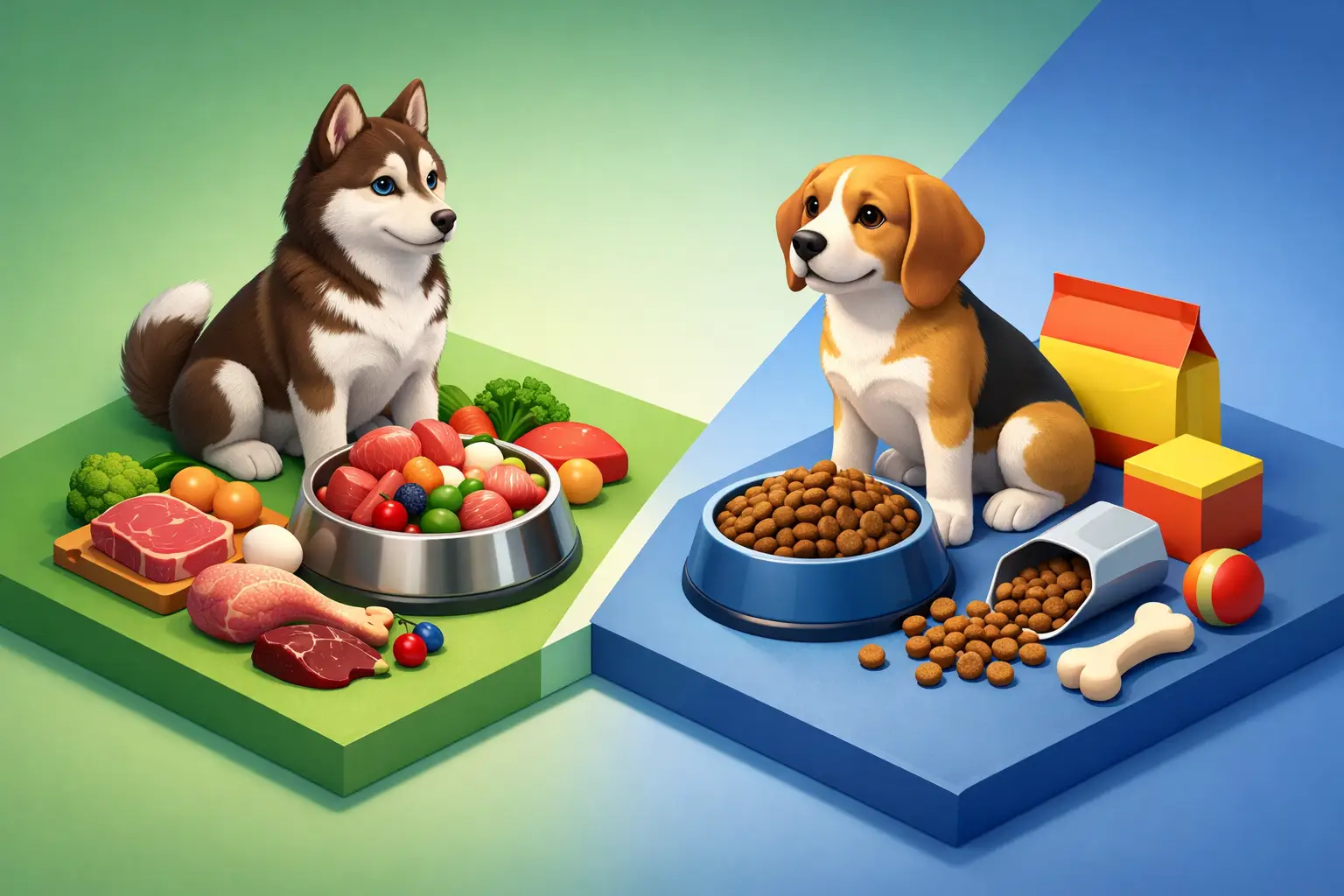
If you have ever looked at your dog’s bowl and wondered whether processed pellets really make sense as a daily diet, you are not alone. The raw food vs kibble dogs debate usually starts with one simple question: what does my dog actually do better on?
That question matters more than marketing claims. Most dogs can survive on kibble. That is not the same as thriving on it. When pet owners switch to a well-balanced raw diet, they often notice practical changes first – smaller stools, cleaner teeth, better coat condition, steadier energy, and more enthusiasm at mealtime. But there are trade-offs too, and they deserve an honest look.
Raw food vs kibble dogs: the real difference
The biggest difference is not just texture or storage. It is how much processing stands between the ingredient and your dog.
Kibble is manufactured through high-heat processing. Even when the label starts with meat, the final product is shaped, dried, shelf-stable, and built for convenience. That process can make feeding simple, but it also changes the food substantially. To make kibble complete and stable, manufacturers usually rely on rendered meals, starches, synthetic vitamin packs, preservatives, and binding ingredients.
Raw food works from a different premise. Instead of building nutrition back into a processed product, it aims to preserve nutrition from real ingredients in a less altered form. A properly balanced raw meal typically includes muscle meat, organ meat, bone or bone content, and other whole-food components in ratios meant to support canine health.
That does not mean every raw product is automatically better, and it does not mean every kibble is equally poor. Quality matters on both sides. But if your goal is ingredient transparency and less processing, raw has a clear advantage.
Why some dogs look and feel better on raw
Dogs are adaptable, but they are still built to digest animal protein and fat efficiently. When owners move from kibble to balanced raw, the visible benefits often line up with that biology.
Digestion is one of the first things people notice. Dogs on raw often produce smaller, firmer stools because there is less filler to pass through. That does not sound glamorous, but it is a useful sign that more of the meal is being used by the body.
Coat and skin can improve too. A dull coat, flaky skin, and chronic itchiness are not always caused by food, but diet can absolutely play a role. When meals contain higher-quality animal ingredients and fewer unnecessary additives, some dogs show better skin condition and a softer, shinier coat.
Dental health is another factor. Kibble is often marketed as if it cleans teeth, but most dogs crunch it once or twice and swallow. It does not function like a toothbrush. Depending on how a raw diet is structured, it may do more to support oral health, especially when the overall diet reduces sticky starch residues.
Energy and body condition can also shift. Some dogs become leaner, stronger, and more consistent in their energy output when they move away from carb-heavy formulas. That said, not every dog becomes a completely different animal overnight. Some changes are dramatic. Others are gradual.
Where kibble still wins
If raw is nutritionally appealing, why do so many owners still feed kibble? The answer is straightforward: kibble is easy.
It stores well, pours fast, travels easily, and does not require freezer space. For busy households or people who are not ready to plan ahead, convenience is a real advantage. Kibble also has a lower barrier to entry. You can grab a bag quickly and feed it the same day.
Cost can look lower too, at least on the shelf. Many kibble products seem cheaper per bag than raw meals. But that comparison can be misleading if the ingredient quality is poor, the feeding volume is high, or the long-term health impact leads to other costs.
The stronger point in kibble’s favor is practicality. For some households, a perfectly managed raw routine is not realistic every single week. That does not make them bad pet owners. It just means feeding has to fit real life.
The biggest mistakes people make in the raw food vs kibble dogs decision
The first mistake is comparing premium raw to bargain-bin kibble and acting like the answer is complicated. It usually is not. If one option is built from real, identifiable ingredients and the other is packed with low-grade fillers and heavy processing, the nutritional gap is obvious.
The second mistake is assuming all raw feeding is balanced by default. Tossing your dog plain ground beef or random scraps is not the same as feeding a complete raw diet. Dogs need balance over time, including appropriate organ content, bone content, and nutrient variety.
The third mistake is treating the choice as ideological instead of practical. Some dogs transition easily. Others need a slower approach. Some owners go fully raw. Others use raw as the primary diet and keep shelf-stable backup on hand for travel or emergencies. It does not have to be all-or-nothing to be meaningful.
What to look for if you are considering raw
If you are thinking about making the switch, the source matters as much as the concept. A raw diet should be more than a trend label slapped on a package.
Look for clearly identified ingredients, balanced meal formulation, and transparent sourcing. You should be able to understand what is in the food and why it is there. Human-grade ingredients, local sourcing, and small-batch production can be strong indicators that a company is paying attention to quality, freshness, and accountability.
It also helps to work with a provider that has a disciplined process. Raw food is not a grab-it-whenever product if it is made correctly and handled responsibly. Planned ordering, cold-chain handling, and clear pickup or delivery coordination are signs that the business takes both safety and product integrity seriously.
That model works especially well for pet owners who want better nutrition without getting pulled into expensive boutique hype. In many cases, a family-run raw food company can offer a more transparent and affordable approach than large national brands because it cuts waste, avoids overpackaging, and stays close to its customer base.
Is raw right for every dog?
Not automatically. Age, health status, chewing habits, digestive history, and owner consistency all matter.
Puppies, seniors, and dogs with medical conditions may need more individualized planning. Dogs with sensitive stomachs sometimes do very well on raw, but transitions should still be handled carefully. If your dog has been eating kibble for years, an abrupt switch can cause digestive upset even if the new food is better.
Owner readiness matters too. Raw feeding asks for freezer space, basic food-handling discipline, and a willingness to plan. For many families, that is completely manageable. For others, it becomes stressful. The right diet is the one you can feed consistently and responsibly.
That is why ready-to-eat raw meals have become such a practical middle ground. They remove a lot of the confusion from raw feeding while keeping the core benefit intact: real food, balanced properly, with less processing.
A fair question about safety
People often raise safety concerns in the raw food vs kibble dogs discussion, and fair enough. Raw food should be handled with care. It is perishable, and it needs proper storage and sanitation.
But safety should be discussed honestly on both sides. Kibble is not risk-free simply because it is dry. Recalls, contamination issues, and ingredient sourcing problems happen in processed pet food too. The real standard is not whether a food is raw or dry. It is whether it is made carefully, stored correctly, and sourced responsibly.
That is one reason many pet owners prefer to buy from smaller producers with transparent systems. When you know how the food is made, when orders are packed, and how pickup or delivery is coordinated, there is less guesswork.
So which one is better?
If you measure by convenience alone, kibble wins. If you measure by processing, ingredient quality, and the potential for visible health benefits, a balanced raw diet usually comes out ahead.
For owners who want cleaner ingredients and are willing to plan ahead, raw is often the better long-term choice. It aligns more closely with what many dogs do best on, and the results tend to show up in ways you can actually see: better stools, better coats, cleaner mouths, stronger body condition, and more excitement around food.
That does not mean every bag of kibble is useless or every raw product is excellent. It means the bowl deserves more scrutiny than a label slogan.
For families in places like Knoxville, Winchester, or Frederick who want a healthier feeding routine without making it a full-time project, the best option is usually a balanced raw meal from a company that values ingredient quality, practical logistics, and straightforward communication.
Your dog cannot read a package, but your dog does live with the outcome of what is in the bowl every day. That is usually the clearest place to start.
Leave a Reply